 SoftGRE
No sections found.
SoftGRE is a self-provisioning GRE Ethernet concentrator for Linux. Access points (or any CPE) tunnel their subscribers' VLAN-tagged Ethernet frames over IPv4 GRE to one server. You never configure a tunnel per AP: when traffic from a new AP arrives, softgred creates its gretap and VLAN interfaces, attaches them to your Linux bridges and opens the bridge firewall for each client MAC it sees. This is the "soft-GRE" model used for Wi-Fi aggregation and hotspots, built from standard kernel parts.
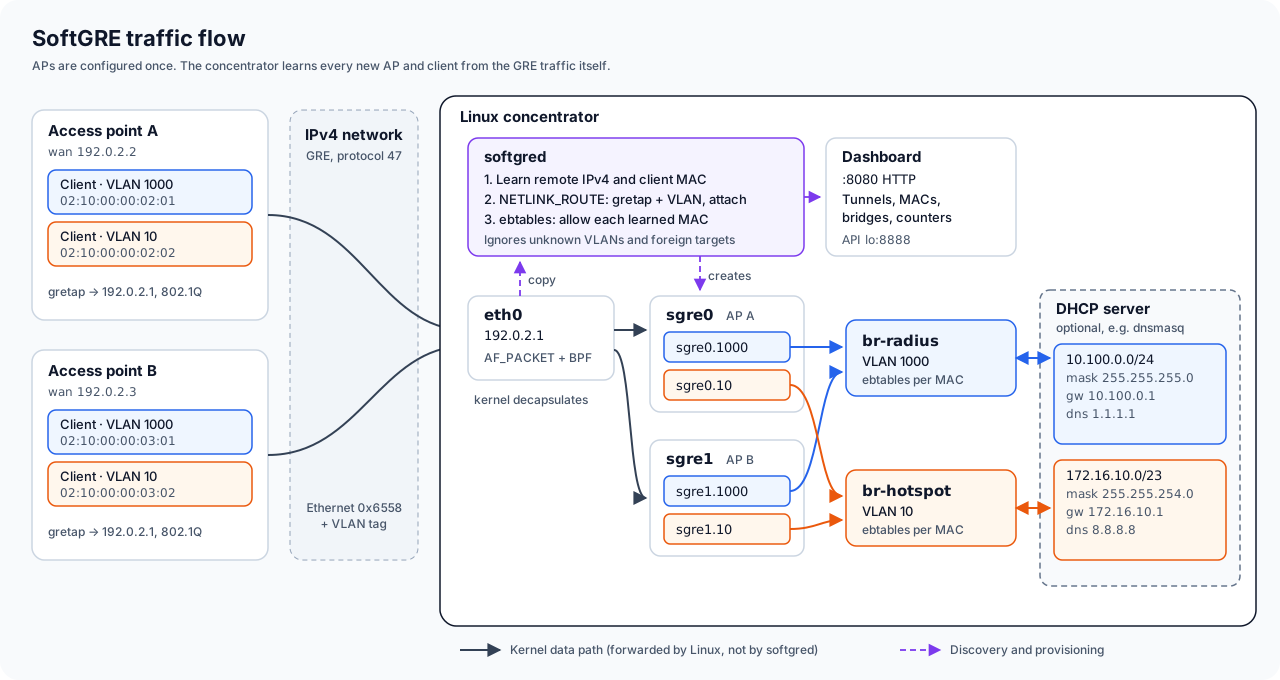
How it works
- The AP side is static. Each AP has a
gretaptoward the concentrator's IPv4 address and one 802.1Q VLAN per service, for example VLAN 1000 for a RADIUS-backed SSID and VLAN 10 for an open hotspot. Clients are bridged into those VLANs. - Passive discovery.
softgredreads a copy of the GRE traffic on the capture interface with AF_PACKET and a kernel BPF filter. It accepts only GRE v0 carrying VLAN-tagged Ethernet (0x6558) addressed to its own IPv4 address, with a mapped VLAN. - On-demand provisioning. The first packet from a new remote creates
sgreNfor it through native NETLINK_ROUTE, plus one VLAN interface for everybridge-mapentry, each attached to its bridge (sgreN.1000tobr-radius,sgreN.10tobr-hotspot). - MAC learning and firewall. Each new source MAC is bound to the remote it came from and gets an ebtables accept rule in the daemon's own
SOFTGRE_INandSOFTGRE_OUTchains. Other traffic on tunnel ports is dropped. Broadcast and multicast toward tunnels stay allowed, so ARP, DHCP and neighbor discovery work. Global firewall rules are untouched. - The kernel forwards. After provisioning, frames flow through
gretap, VLANs and bridges entirely in the kernel. The daemon only handles discovery. - Services sit behind the bridges. Each bridge is a separate service network. Routing, NAT and an optional DHCP server live there, so every VLAN can hand out its own subnet, mask, gateway and DNS.
What you get
softgred, a small C daemon with a bounded packet parser and onepollloop.- A read-only TCP API and a Python dashboard with tunnels, learned MACs, bridge membership and packet counters.
- An event log of every tunnel, VLAN attachment and learned client, with logrotate support.
- A dnsmasq lease hook that records which AP and tunnel each DHCP lease came through.
- Debian and Ubuntu packages, a production container image and systemd units.
- Docker labs, from a single container with synthetic packets to a gateway with simulated APs sending real GRE and requesting DHCP leases.
Scope
SoftGRE accepts IPv4 outer transport, unkeyed GRE v0 and one inner VLAN per frame. Learning a MAC is discovery, not authentication, so restrict who may provision with the allow-remotes allowlist and keep GRE to trusted remotes. There is no built-in RADIUS, DHCP server, shaping or failover; those services attach to the bridges. See Architecture and security for the full protocol scope and trust model.
Where to go next
- Try it with Docker: run a gateway with simulated APs, or the single-container lab, without touching your host network.
- DHCP and subscriber services: one network per bridge, the lease hook and DHCP option 82.
- Install and deploy: packages, container image, source builds and systemd.
- Configuration and operation: settings, signals, logs and troubleshooting.
- API and dashboard: TCP commands and the Python and PHP adapters.
- Architecture and security: capture, provisioning, firewall and limits.
- Development and testing: test suites, formatting, releases and this site.